

Thailand Urges Exporters to Join Western China’s Supply Chains as US Probes Auto Parts and Batteries
Thai exporters encouraged to tap the economic growth of western China
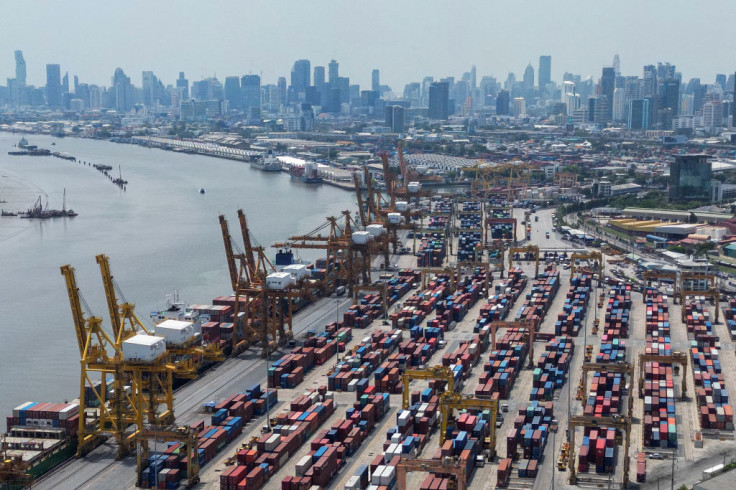
BANGKOK — Thailand's Department of International Trade Promotion is urging exporters to view western China not simply as a market, but as a supply chain in which they should participate.
In an analysis published this week identifying Chongqing, Chengdu and Xi'an as a "Western Triangle" of commercial opportunity, the department, which operates under Thailand's Ministry of Commerce, said Thai businesses should establish a presence in inland China, join regional production networks and use direct rail links to access markets in Central Asia and Europe.
The recommendations vary by sector. Chongqing is presented as a base for industrial business-to-business partnerships, auto components and raw materials. Chengdu is positioned as a consumer gateway for lifestyle products, functional foods and wellness goods. Xi'an is highlighted as an entry point into high-tech supply chains and cross-border e-commerce.
The numbers behind the pitch
The underlying data is striking in its own right.
China's GDP grew 4.7 percent year on year in the first half of 2026 to 69.57 trillion yuan, while high-tech manufacturing expanded 13.3 percent. Output of 3D-printing equipment rose 48.5 percent, lithium-ion batteries 39.3 percent and industrial robots 28.0 percent.
Chongqing recorded first-half GDP of 1.67 trillion yuan. Lithium-ion battery manufacturing jumped 63.2 percent, while exports of automobiles and components surged 66.9 percent. Retail sales reached 849.1 billion yuan, the highest among China's regions. Chengdu's economy grew 5.0 percent to 1.28 trillion yuan, with services accounting for nearly 70 percent of output.
Xi'an was the standout performer. Its imports and exports rose 96.2 percent to 450.2 billion yuan, the fastest growth among China's 20 leading trading cities. Memory chips and integrated circuits accounted for more than three-quarters of the increase.
The other conversation
Thailand's Ministry of Commerce is also involved in a second set of discussions covering many of the same industrial categories.
Deputy Prime Minister and Commerce Minister Suphajee Suthumpun said Friday that Thailand and the United States had agreed on the main terms of a reciprocal trade agreement after talks in Washington on Sept. 1 with the US trade representative. She said US officials had assured Thailand that tariffs resulting from a Section 301 investigation into structural excess production capacity would be "fair and competitive."
The investigation covers vehicles and automotive parts, rubber products and machinery. A second Section 301 case examines whether trading partners prohibit imports of goods made with forced labor. It would impose a 12.5 percent tariff on economies without such a prohibition and 10 percent on those making qualifying commitments.
Thailand's exposure in the first investigation stems precisely from its manufacturing links to the sectors in which the department is now advising exporters to deepen their engagement.
Two positions, yet to be reconciled
Neither position is unreasonable on its own.
Trade promotion agencies are tasked with identifying markets, and western China is clearly growing rapidly. Trade negotiators are tasked with securing favorable tariff terms, and Thailand's 19 percent reciprocal rate was set in a framework published last October. Both sides are doing their jobs.
But they are part of the same ministry, and the two messages point in different directions within weeks of each other. One urges Thai manufacturers to embed themselves in China's automotive and battery industries. The other is negotiating tariff treatment in an investigation focused on the industrial capacity represented by that production.
Nothing the ministry has published reconciles the two positions, and no one appears to have asked it to.
What the region's opinion-makers think
There is another layer to the issue, complicating any straightforward interpretation.
The ISEAS – Yusof Ishak Institute's State of Southeast Asia 2026 survey, published on April 7, found that 87.5 percent of Thai respondents were concerned about China's growing political and strategic influence. That was among the highest levels in the region, alongside the Philippines and behind Vietnam.
The survey also found that 88.3 percent of Thai respondents were concerned about growing US influence, the highest figure recorded for any country surveyed.
Thailand, in other words, is not simply wary of Beijing. Its opinion-makers are more uneasy about Washington than those in any other Southeast Asian country, while remaining nearly as uneasy about Beijing. When asked to choose between the two powers, 55 percent of Thai respondents selected China.
⚠️ The survey covered 2,008 opinion-makers and thought leaders across 11 countries, including academics, private-sector representatives, civil society and media figures, government officials and staff of regional organizations. It was not a survey of general public opinion, and presenting the figures as the views of "Thais" would misrepresent what it measured.
What to watch
Whether the Section 301 excess-capacity ruling names specific sectors. If the outcome distinguishes between industries, Thai exporters of automotive components will learn whether deeper integration with China could carry a tariff cost. If it does not, the department's advice will remain unaffected.
Whether the reciprocal trade agreement addresses supply-chain origin. Thailand's customs administration already operates an anti-transshipment regime and has identified 413 suspected cases from more than 43 million declarations since April 2025. The key question for companies following the department's advice is whether the agreement will add further obligations.
Whether trade promotion and trade negotiations are publicly coordinated. Two arms of the same ministry are currently addressing exporters and Washington separately. A single ministerial statement explaining how the two approaches fit together would answer the question raised by this article. Its absence is itself informative.
Originally published on IBTimes Thailand