

China’s Navy Surpasses US Fleet in Ship Numbers, With More Than 370 Warships
The widening gap between China's expanding fleet and America's shrinking naval force
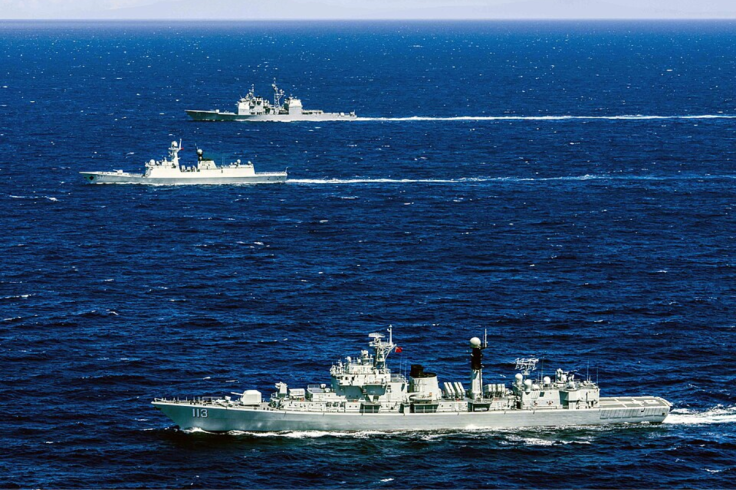
China's navy has become the world's largest by number of ships, with the US Department of Defense reporting more than 370 battle-force platforms in 2024. The US Navy, by contrast, had 291 battle-force ships as of 2026. The disparity reflects a decline in the size of the American fleet that has taken place over several decades.
The gap marks a dramatic reversal from the final years of the Cold War, when the US Navy operated 594 active ships in 1987 amid the Reagan administration's push for a 600-ship fleet. Nearly four decades later, America's naval numbers have fallen by more than half, even as Washington seeks to maintain its presence across the Indo-Pacific.
The United States is arguably in its weakest relative military position in the Indo-Pacific in a generation.
— Dr. Alice Frost (@PoliSciChick84) September 2, 2026
The United States has a fleet of only about 290 battle-force ships, far smaller than the 500-plus-ship Navy of the late Cold War and well below the force structure the…
China's Shipyards Show No Sign of Slowing
The People's Liberation Army Navy has moved well beyond a coastal defense force focused primarily on protecting China's shoreline. It now includes submarines, amphibious vessels and aircraft carriers capable of supporting longer-range operations across the Western Pacific and beyond.
China commissioned its third aircraft carrier, the Fujian (CV-18), in November 2025. The carrier is the most advanced in China's fleet, incorporating electromagnetic catapults and other capabilities that distinguish it from the country's two earlier carriers.
Construction is also under way on a fourth carrier at Dalian Shipyard, commonly referred to as the Type 004, although details about the vessel remain uncertain in open-source assessments.
According to the Congressional Research Service report, 'China's Naval Modernisation: Implications for U.S. Navy Capabilities' (updated in February 2025) and cited by USNI News, China's navy surpassed the US Navy in battle-force ship numbers during the second half of the 2010s.
US Department of Defense projections have estimated that China's fleet could reach roughly 395 battle-force ships by 2025 and about 435 by 2030. The figures underline that the current numerical disparity is not the result of a sudden shift, but of sustained naval expansion over many years.
If China's shipbuilding programme continues at its current pace, the numerical gap could widen further. Dr Sidharth Kaushal, a naval analyst at the Royal United Services Institute, told IBTimes UK: 'The industrial capacity gap is the real story here. The US cannot build its way out of this in under a decade.'
When people say let's build our ships offshore - either commercial or military - let's remember a few key facts.
— Sal Mercogliano (WGOW Shipping) 🚢⚓🐪🚒🏴☠️ (@mercoglianos) August 27, 2026
▶️China is the largest single shipbuilder in the world - they have over 70% of the commercial shipping orderbook in 2026
▶️They are rapidly building a blue-water Navy… https://t.co/BKq0FPotsA
Decades of Decline: Why the US Cannot Keep Up
America's decline has not resulted from a single decision, but from years of retiring older vessels without replacing them at the same pace. US officials and government assessments have identified shipbuilding delays, maintenance backlogs and limited capacity across the country's naval industrial base as significant challenges.
China's shipyards, meanwhile, continue to produce surface combatants, submarines and aircraft carriers at a high rate. The difference in shipbuilding capacity means that even as Washington plans to expand its fleet, it faces a slower path to higher numbers than Beijing does to further growth.
Rebuilding the US fleet will require more than simply funding new ships. Shipyard capacity and repair infrastructure will also need to be expanded sufficiently to turn fleet expansion plans into vessels entering service.
Why Ship Numbers Do Not Tell the Full Story
Ship count alone does not tell the whole story of naval power. The US Navy operates nuclear-powered aircraft carriers, Virginia-class attack submarines and Arleigh Burke-class destroyers equipped with advanced sensors, air-defense systems and long-range weapons that outmatch much of China's fleet.
The United States also retains significant advantages in areas such as global logistics, operational experience and overseas basing. Those advantages, however, come at a cost.
A smaller fleet puts greater pressure on deployments, crew rotations and maintenance schedules worldwide.
This limited capacity also reduces flexibility during simultaneous crises. If tensions rise in more than one region at the same time, the US Navy has fewer ships available to respond without pulling vessels away from existing commitments elsewhere.
The numerical gap nevertheless carries significant implications for global naval deterrence, even if the United States retains important qualitative advantages. China's growing fleet gives Beijing greater capacity to conduct operations farther from its coastline, including around Taiwan and along strategically important maritime routes.
A shrinking US fleet, meanwhile, could have less flexibility to respond to multiple crises simultaneously, potentially affecting perceptions among allies and partners in the Indo-Pacific and beyond.
Closing the gap will depend not only on ordering new ships, but also on whether America's shipyards can rebuild the industrial capacity needed to turn those orders into finished vessels.
That challenge is likely to shape naval strategy and alliance planning for years to come. For US allies in the Indo-Pacific, the question is no longer whether China can challenge American naval dominance, but when the industrial gap makes that challenge impossible to ignore.
Originally published on IBTimes UK
© Copyright IBTimes 2026. All rights reserved.